Tuesday, August 25, 2009

Premiata Forneria Marconi- L’isola di niente


We’ve gone from well known to obscure and now back to well known for this Italy month. Premiata Forneria Marconi, commonly referred to as PFM, translates as “Award Winning Marconi Bakery”. The core members spent the second half of the 60’s as session players for many Italian pop stars, and officially formed PFM in Milan during 1970. They were one of the rare Italian bands, prog or otherwise, to gain some fame outside of Italy in the Anglophone world by recording some English spoken albums. L’isola di niente (The Island of Nothing) is the third Italian language album from the group, released in 1974. For this album, the lineup was Franz Di Cioccio (drums/Vocals), Patrick Djivas (bass/Vocals), Franco Mussida (guitars/vocals), Flavio Premoli (keyboards/vocals), and Mauro Pagani (violin/flute/vocals).

L’isola di niente starts with its title track. This itself starts with 2:30 of choral chants, a throwback to the liturgical traditions of Italian music. However, a nice guitar riff then takes us into the hard hitting meat of the song. The vocals here are quite strange, but the guitar playing really leads the way, with both electric and acoustic passages. The keyboard work is very sweet and pastoral to accompany. This song truly fits the “symphonic” in symphonic prog. Afterward, we have “Is my face on straight”, the only English song on the album. Due to this, vocals truly lead, and we do suffer from some of that ESL loss to translation. However, there’s a nice carnival like atmosphere to the track, with some nice keyboard work. Also of note is the strong presence of the flute in the background which helps carry the song along.

On side B of L’isola di niente we have three tracks. First is “La luna nuova”, which starts with quiet percussion and then leads into a violin melody. This song shows PFM at their most rhythmic. The synths used on this song go way be on the line of acceptable tackiness, unfortunately. There’s not too much else to make up for it, but there’s some good bass playing in particular. This one also has the festive feel. Next up is “Dolcissima maria” a 4 minute track. This sounds like it’s probably some sort of ballad. As would be expected, it’s soft, with lots of acoustic guitar. Overall, it’s a very sweet little piece that I wish I could translate. The final song on the album is “Via lumiere”, it starts with quiet bass and later guitar exercises, before, going into a hard edged assault of distorted violin and guitar. It alternates between some quieter passages and then more of the rock. This song is the most experimental and most rewarding of the tracks on L’isola di niente.

When looking at the album as a whole, I see lots of small strengths rather than anything spectacular or mind blowing. Likewise, the flaws are all minor and overlookable. What saves this from the curse of the average is that the playing is very articulate and professional. Also, “Via lumiere” provides a big boost to the rest of the album with it’s interesting loud/ soft contrasts.

I’d highly recommend this one to fans of prog, especially Italian prog. A strong effort with many little goodies to offer, I give it a Grade of B-.

Friday, August 21, 2009

Italy and Prog: An Ideal Environment, Part 2

The Prog scene in Italy was mostly a northern affair, as south of Rome poorer people stuck with older musical tradition. There was more in the way of a festival scene in the country, as opposed to the mostly solo concerts of other prog bands. “The festivals were often free of charge and boasted a level artistic freedom and competition seldom seen in popular music. Fans witnessed bands rise from obscurity to compete on the same stage as the heavy hitters. This musical competition created something of an upward spiral; everyone tried to outdo each other, producing unique sounds and incorporating disparate influences into their music. The variety of the music went through the roof, with every band sharing the same aspirations, though seldom the same sound.” [3] The avant-garde took decent hold in the mid 70’s, for example.

However, as time went on, Italian Prog suffered the same fate as British and American prog. By 1980, the scene dried up almost completely, with good albums fewer and farther between. Despite this, Italy left so many strong albums in its wake that it most certainly owns the title of one of the three most productive nations for classic prog, along with the UK and Germany.

Major bands include:

· Le Orme- I reviewed their Felona e Sorona album earlier this month, and information on their early carrer can be found there. After that album and 1974’s Contappunti, they started to decline in quality, but only after leaving a few classic albums of Italian prog showcasing the greatness of their electronics.
· Premiata Forneria Marconi- Perhaps the most famous of the RPI bands. Relased several albums, some of which even made a mark in the United States when in their English version. Their guitar work is defiantly amongst prog’smost inventive.
· Banco Del Muto Sorccorso- The last of Italy’s “Big Three”, they are also the only of the three whom I don’t own an album. From what I’ve heard on the internet, they have a thicker sound than contemporaries while still staying not far off from the Italian model. Also had some very political lyrics.
· Goblin- Evolved from Cherry Five, who’s album I reviewed last week. Famous for their horror movie soundtracks, particularly for Suspiria, Goblin also released some non- movie material.
· Area- This band is more into the jazz aspect of prog. Relased several higly rated albums in the mid 70’s, some of the stuff I’ve heard from them are quite fast and use interesting timbres.

Sadly, Italian bands all too often only released one album and disappeared, hindering there being many worth mentioning in an article this broad.

[3] http://www.progarchives.com/subgenre.asp?style=28 , “Rock Progressivo Italiano Definition”

Sunday, August 16, 2009

Cherry Five- Cherry Five


Talk about an obscurity. This Italian quintet consisted of Tony Tartarini [aka Toni Gionta] (vocals), Claudio Simonetti (keyboards), Massimo Morante (guitar), Fabio Pignatelli (bass), and Carlo Bordini (drums). I’m not going to go into too much history, as it’s very broad, but as a point, Cherry Five lived in London for a while (with an English singer), and their members come from various other bands and places. As far as a style, they are something like Genesis or ELP, but with a bit of a space rock edge. Released in 1974, Cherry Five’s self titled album is their only release, and also is sung in English.

Cherry Five opens with “Country Grave Yard”, a bombastic symphonic rocker. Pignatelli’s bass brings to mind Chris Squire of Yes here. Also of note is the strong keyboards and guitar. While Tartarini defiantly is a good vocalist in the technical sense, it’s obvious his skills with English are not the greatest. This doesn’t really detract too much from the vocals on the album, but it is slightly humorous. The sheer bombast is best part of this song. Afterward, we find “The Picture of Dorian Grey”, about the novel of the same name. This track is really similar to “Country Grave Yard” as far as the production, but it overall feels more lighthearted and more melodic. The guitar riff leading into the lyrics stands up there amongst my all time favorites. If listening closely, there’s some really great drum work on this song true. Next comes “The Swan is a Murderer, Part 1”. At 4:25, it’s the shortest song on Cherry Five. Here we have a keyboard led track to the extreme, it sounds like harpsichord or harpsichord like synthesizer was used. The song builds up with lots of emotion before transitioning to a creepy voice and bell noise section and fading out.

Those “voices” kick the next side of the album of to start “The Swan is a Murderer, Part 2”. The guitar plays a larger role than the keyboard this time, and close listening will also reveal a strong bass presence. But, it’s more or less the same as part one (not a complaint). On a piano, “Oliver” starts a long journey. At 9:33, it’s the album’s longest track. It also moves the slowest at many parts. The tempo allows for more ethereal keyboard and bass parts. The vocals, however, are at the medium fast tempo of most of the album. The last track is “My Little Cloud Land”, which is unfortunately its weakest. The vocals here are boring, for some odd reason, occasionally monotone. The keyboards and bass are redeemable enough, however.

The biggest problem, which isn’t all that big, is the music isn’t very original, they’re merely adding their take on what’s been done before. However, the value of the composing and playing is very strong, and it’s not hard to tell they really cared about their music. After Cherry Five disbanded later in ‘74, Moronte, Pignatetlli, and Simonetti would go onto form Goblin, a band famed for their soundtracks to horror films.

Definitely a lost gem of Progressive Rock. The best of Italian prog with a strange and ghostly twist. Grade: A-

Saturday, August 8, 2009

Italy and Prog: An Ideal Environment, Part 1

For Italy month, I looked over my collection for good review material. Out of hundreds, perhaps thousands, of Italian Prog albums, I only own 4. This shows that I’m quite a newcomer. However, it’s of note that I enjoy all 4 of them quite a bit. Today I’ll go into a two part study of what made Italy such a fertile place for prog, and do something of a research project into some bands I’ve just not gotten around to hearing yet.

As I’m sure we all know, Italy has defined western music perhaps more than any other region. Much of the terminology, instruments, and forms common to the West have an origin in the conservatories and concert halls of Rome, Florence, Venice, and Milan amongst other cities. Obviously, young Italians have nationalistic pride, which leads to incorporation of this tradition into the prog of Italy. Out of all the prog scenes, Italian Prog (Rock Progressivo) has the most classical influence, and less of the electronic experiments and jazz-like textures. Opera seems a particularly big influence, as Italian prog has a great emphasis on storytelling. Also, an abundance of acoustic guitar can be found in this music. This stems from the Italian folk tradition. Of course, there are some Jazz Fusion and Hard Prog bands from Italy, but in general, Italy’s musical past drives the direction of its progressive work.

“No overview of RPI would be complete without mentioning the use of the Italian language, by many considered one of the most musical languages in the world. It could be safely stated that the use of Italian is inherent to the soul of RPI, a critical component to the full appreciation of the subgenre. In fact, even if some key RPI albums were translated into English in an attempt to gain international recognition, most of them fail to impress.”[1] When the Italians attempt to sing in English, we often run into blocky phrases such as “You would sell your soul to Devil, Dorian Gray”[2]. While this can often be looked over, the nature of the Italian Prog being so heavily linked to Italian History lends the music to best delivery when in Italian. Even when you can’t understand the language, you can still enjoy how it can work with the instruments.

Much like the Anglophone world, the political climate of Italy led to great opportunities for a progressive rock scene to come to fruit. The nation’s great economic boom of the 1960’s led to more affluence, and highly educated people are the ones that make prog. Additionally, liberalism continued to grow over a traditionally conservative country. With lots of organized crime and anarchy, the stress and socio-political climate was right for creative was to protest.

It took approximately two years for Prog Rock to travel from the United Kingdom to Italy, but by 1971, the art had spread. Not even highly reactionary forces like the Catholic Church or Communist party prevented Prog from gaining strong footing in the Italian culture. Very similarly to the United States, high amounts of government inefficacy and lots of crime inspired young, restless teens and twenty somethings to use art as a way to change society. This led to the same transitions as can be seen in the US and England where non-prog bands decided to take that route. Psychedelic and Avant Garde influences started to import themselves first, followed by the progressive ones. Genesis, who had trouble gaining popularity in England at first, were beloved in Italy early on. The “Disco effect” took hold, where nearly every artist released some progressive work.

To be continued later this Month!

[1] http://www.progarchives.com/subgenre.asp?style=28 , “Rock Progressivo Italiano Definition
[2] Cherry Five, “The Picture of Dorian Gray”

Tuesday, August 4, 2009

Le Orme- Felona e Sorona


Today we begin Italy month on the blog, celebrating the rich progressive rock scene of that country. What better way to start than with my first Italian Prog album, Felona e Sorona by Le Orme. This band was founded in Venezo all the way back in 1966 as a four piece, but by the time this was released in 1973, only guitarist/vocalist Aldo Tagliapietra remained from that lineup. The band had reduced to a three piece, rounded out by Toni Pagliuca on keyboards and Michi Dei Rossi on the drums. Originally a psychedelic pop band, Le Orme transferred into prog during the early 70’s. Felona e Sorona is the fourth album in their discography. This album is a concept album, telling the tale of two planets. Felona is prosperous and happy, while Sorona is a horrid world filled with famine and plague. However, the fates of the two invert. Since I don’t speak Italian, I can’t say any more about the plot than that.

Felona e Sorona is relatively short for a Prog album, lasting under 35 minutes. 8:46 of that makes up “Sospesi nell 'incredibile”, the opening track. It features ethereal sounding keyboards and synths, and sounds generally spacey and isolated. The bass work here provides a solid backing for creeping synthesizer work. Overall, a good piece of prog. This is followed by “Felona”, a very short piece of bells and acoustic guitar, with an upbeat vocal. Here the band makes it quite obvious that Felona is a great place to be, but those ghostly keyboards tell something is beginning to go wrong. Another short piece “La solitudine di chi protegge il mondo”, follows with nice grand piano fills. “L'equilibrio” then begins and suddenly adds energy and aggression to the momentum of the album. More keyboards here, and this one sounds very similar to “Sospesi nell 'incredibile”, but with grand piano added. On to side two.

To accomapny “Felona”, “Sorona” gets its turn in the spotlight. As would be expected, the music is slow, gloomy, and ghastly. Another song that fits the mood it wants to portray perfectly. Follow up songs “Attese inerte” is more of the same keyboard driven mid tempo work that the band played on side A, while “Ritratto di un mattino” echoes “Sorona” very closely for its first half before switchign to “Felona” like structure. “All'infuori del tempo” continues this upbeatness with the acoustic guitar coming back to a prominent role. The album ends with a song called “Ritorno al nulla” which finally injects some needed originality to this album. Here we have the gloominess of the other numbers, but at a faster pace. Thus song defiantly sounds very alien, and ends with bombastic amounts of synthesizer.

Felona e Sorona has numerous strengths. The acoustic guitar pieces prove very nice on the ears. The real star of the show is the keyboards, as Pagliuca adds multi layered keyboards to the mix in spectacular fashion. Le Orme’s great strength lies here. However, there are weaknesses to the album. For one, the repetitiveness is extremely high, even for a concept album. Additonaly, the album aside from the keyboards is pretty generic and uninventive. On the whole however, we have a solid album showing off the greatness of the Italian keybaord in Progressive rock.

Pound for pound, this one falls short of being an essential. However, the keyboard work here has much to recommend, and the album definatly will turn listeners on to the Prog scene of Italy. Grade: B-

Thursday, July 30, 2009

Yes Concert Review

So, two days ago, I went to see Yes play on thier In the Present tour at the Tower Theater in Upper Darby, PA. As thier opening act, they had Asia, since Steve Howe was in both bands. All I have to say is I was TOTALY AMAZED! Most prog fans consider Asia a disgrace of sappy pop by prog greats, but this concert proved that's not true. As for Yes, they were fantastic.

Asia has a 9 song set, and I can't really tell you everything that was on it since I'm not familiar with thier distography. The Asia origonals sounded really good, but the higlights were songs from the member's former carrers. For Geoff Downes, they played "Video Killed the Radio Star" by the Buggles. John Wetton got "In the Court of the Crimson King", which initially struck me as odd, seeing he wasn't in King Crimson till 4 albums after In The Court. Then I saw why: Ian McDonald came out to guest on flute! For Carl Palmer, they played "Fanfare for the Common Man", with a fan-tastic drum solo. Honestly, in both bands, Carl was the best player all night. Wetton and Downes played really energetically too. Steve Howe looked like he wasn't too in to it, since he probably wanted to get on to the Yes set. Overall, good stuff.

As for Yes itself, I was blown away. Since Jon Anderson is sick with resperatory problems, Benoit David of Montreal Canada got to be vocalist, and since Rick Wakeman more or less comes and goes in and out of Yes as he pleases, his son Oliver did the 'boards. Then, of course, there was Howe, Squire and White. Chris Squire was the show stealer, moving around his part of the stage and really going at that bass with is distinctive pseudo- slap style. Howe was much more into the Yes stuff than Asia, and Alan White definatly preformed well on the drums. His solo can't hold a candle to Palmer's, but then again, not much can. David not only sounded very similar to Anderson, he looks like him, too! His perfomance was strong. Wakeman was sort of invisible compared to the other four, but did his job well. Here's the setlist, with asterisks next to songs done paticuarly well:

Firebird Suite
Siberian Khatru*
I've Seen All Good People
Tempus Fugit*
Astral Traveller*/ Drum Solo
And You and I
Steve Howe Solo
Owner of a Lonely Heart
Machine Messiah
Roundabout
Heart of the Sunrise*
Starship Trooper* (Encore)

The best concert of my life. Be sure to catch them next time they come to town!

Monday, July 27, 2009

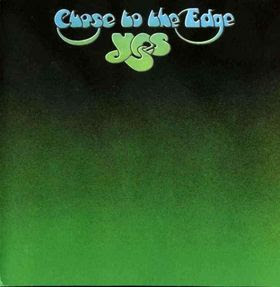
Yes- Close to the Edge

Tomorrow, I’m going to my first ever prog concert, Yes. To commemorate, I’m reviewing the album that generally is considered their best, Close to the Edge. At this time in their carrer, Yes consisted of Jon Anderson (lead vocals), Steve Howe (guitar/vocals), Chris Squire (bass/vocals), Bill Bruford (drums), and Rick Wakeman (keyboards). The band had broken through with The Yes Album (1971), and became one of Prog’s superstars with Fragile (1972). With these strong albums under their belt, Yes made Close to the Edge with little reservation.

This album is the first of a few more by Yes that are centered around one massive track, with shorter ones taking up what’s left of the record. In the case of Close to the Edge, this is the title track. “Close to the Edge” contains four distinct parts making up an 18 minute suite: The Solid Time of Change, Total Mass Retain, I Get Up I Get Down, and Seasons of Man. For the first movement, nature sounds lead into the album. After about a minute, Howe takes over with a truly amazing guitar solo. His style here is very Prog at heart, with lots of fast and technical chord changes and time changes. This, after a semi- stop, leads into the vocal harmonies, with Anderson’s distinct high pitch voice caring the piece (due to a vocal cord defect, he sings in a permanent falsetto.) The song goes through its chorus several times, with little changes between each repetition. The Total Mass Retain phase is brief (less than two minutes), and is very similar in style to what came before. I Get Up I Get Down starts, and suddenly everything mellows. Wakeman adds some keyboard sounds to carry over for a while. This section has little music for its beginning, with just vocal parts over the electronic sounds. Wakeman adds a pipe organ solo at the end. Seasons of Man returns to the structure of Solid Time of Change, with the same guitar, bass, and drum parts. The Keyboards, however, are different. After a vocal only reprise of the other parts, “Close to the Edge” fades out.

That song takes up a whole side of vinyl, but the songs on side B are no slouches either. The first of two songs here is “And You and I”, a love song. Once again, it is a suite, lasting 10 minutes. It also has 4 sections: Chord of Life, Eclipse, The Preacher and the Teacher, and Apocalypse. The sections are less distinct here. Howe’s Acoustic guitar leads in, and he puts in a fantastic performance. Anderson solos for much for much of this song, and his frail voice perfectly fits the lyric content. “And You and I” talks about how when in love, a person is incomplete without the other, and how lovers ought to try to spread this message of Love. This is all done in extremely spiritual way. The keyboards help to create an ethereal mood during the second half of this song. Perhaps Prog’s greatest Love song, it ends by stripping down to the basic guitar part and vocal. Lastly, there’s the nine minute “Siberian Khatru”, the first Yes song I ever heard. After an opening riff, the song has a four measure structure, with three 4/4 ones followed by a 3/4. Vocals come in after about a minute. This song is not a multi part suite, but features many solos by Wakeman and Howe. Squire’s distinctive bass style is very evident on this song, with many slap-bass like notes. Bruford also shine on the drums. “Siberian Khatru” has an energetic feel as parts, but at other parts feels as icy as Siberia.


Close to the Edge was heavily influenced by the book Siddhartha by Hermann Hesse. Stravinsky’s The Rite of Spring also factored into the feel of the album. Roger Dean, the famed Prog Artist, contributed the gatefold illustration, which featured the signature sci-fi landscapes of his work for Yes (above, image from Wikipedia). After this album, Bruford left to join King Crimson, and Yes released Tales from Topographic Oceans (1973), which was received with mixed attitudes.

Close to the Edge is one of the best known Progressive rock albums, and deservadely so. It has great art, lyrics, guitar, bass, drums, keyboards, vocals, and is inventive. What more can we ask from a Prog Album? Not much. Grade: A