Showing posts with label Yes. Show all posts

Friday, February 11, 2011

Bill Bruford: The Autobiography


Another blog first: a book review. I just got done reading Bill Bruford's autobiography, published in 2009 as he was retiring from the stage.In 350 pages, Bruford muses over his story with typical English humor and numerous anecdotes.

Rather than being some sort of chronological tale, Bruford categorizes things by topic. Loosely. Each Chapter starts off with a F.A.Q., anf the sections of the chapter range from highly relevant to the question to mercilessly off topic. He also spends almost no time on Yes, with probably no more that 20 or 30 pages on the subject. Bruford instead opts to focus on King Crimson and his solo carrer in jazz. If anything, Bruford makes his life story out to be one of a slow musical growth from rock into jazz, the music that truly captivates him. Therefore, if you're just reading for stories about days of prog rock glory, you'll probably not find this a great read.

However, the book is not that. It is an excellent read. In its passages one gets to see the true mentality of a Prog Rock musician, what it quests for, and the end result. In the end of it all, Bill Bruford's journey led him to leave Yes because he felt he couldn't continue to grow as a musician there, leave King Crimson for the same reason, and retire at his peak. All throughout, Bruford is witty, approachable, and somewhat self depreciating. I'd have liked to read a bit more about the Prog Rock days, but this was an excellent on sight purchase at the book store. Grade: B+.

Friday, June 18, 2010

Yes-Relayer

It's been ages since I've done a Yes album on here. Let's fix that. Due to the major personality clashes within the band, Rick Wakeman decided to leave Yes after the prior album, Tales from Topographic Oceans, leaving the much more permanent fixtures of Anderson, Howe, Squire, and White to find a new keyboardist. The lucky individual turned out to be Patrick Moraz, a Swiss keyboardist. In 1974, the band created Relayer, yet another album with all of those Yes touches, but with its own little quirks.

This album has a side-long epic on the A side, called "The Gates of Delirium." Anderson supplies lyrics with a lot clearer message than regular, and this track is clearly a war epic. The song starts out with a two minute keyboard workout. Moraz' style is a bit more modest than Wakeman's, but is just as good. Then the vocal comes in, and all of the Yes elements come together in good old fashion. Squire does the best at leaving an impression in here, but they keyboard Bridges do a fine job also. There are many movements during this song, and they all have a 4/4 or 6/4 time signature and similar chord structures, but the melody varies vastly. After about the 8:00 mark, Anderson stops, and the song goes into an instrumental powerhouse. Howe really does the shining here, and his ever adaptable guitar has one of a few career highs here. The style of this section is all about going for a massive wall of sound. At the 15 minute mark, everything screeches to a halt and becomes a slow, "after the battle" type song. This section was originally a separate song called "Soon." Anderson sings some sappy vocals, and it all draws to a close. While it ends with a whimper, the beginning sure is a bang.

Side B has pair of nine-minute tracks, starting with "Sound Chaser", which gets so crazy that it more or less lacks a time signature in parts off the song. The title is apt. The keyboard work here is terrific, and very frenzied. "Sound Chaser" also has a nice bouncy rhythm, and Howe has a very nice guitar solo. The finale is called "To Be Over". This song is much slower in tempo, and is very simplistic. It almost reminds me of a lullaby at parts. There's some tacky 70's production and touches. The musicians don't stand out, and overall this is just not all that good. It fails to live up to the other two tracks on this album.

Relayer is something of a schizophrenic record. Between the chaos of the beginnings of the record sides and the sereneness of the second portions, Relayer struggles to find that consistent grove that can be seen on Close to the Edge or Fragile. However, there is a lot to like here, with a variety of strong players (especially the underrated Moraz, who unfortunately was not a good live keyboardist), just doing what feels right at the time. Each ones gets their fair share of space, and takes their performances to a great level of proficiency. After this album, Yes went on a 3 year hiatus, and all the members released solo albums.

While not the best Yes album out there, Relayer has much to offer and is an album you should have in your Prog collection. Grade: B+

Thursday, July 30, 2009

Yes Concert Review

So, two days ago, I went to see Yes play on thier In the Present tour at the Tower Theater in Upper Darby, PA. As thier opening act, they had Asia, since Steve Howe was in both bands. All I have to say is I was TOTALY AMAZED! Most prog fans consider Asia a disgrace of sappy pop by prog greats, but this concert proved that's not true. As for Yes, they were fantastic.

Asia has a 9 song set, and I can't really tell you everything that was on it since I'm not familiar with thier distography. The Asia origonals sounded really good, but the higlights were songs from the member's former carrers. For Geoff Downes, they played "Video Killed the Radio Star" by the Buggles. John Wetton got "In the Court of the Crimson King", which initially struck me as odd, seeing he wasn't in King Crimson till 4 albums after In The Court. Then I saw why: Ian McDonald came out to guest on flute! For Carl Palmer, they played "Fanfare for the Common Man", with a fan-tastic drum solo. Honestly, in both bands, Carl was the best player all night. Wetton and Downes played really energetically too. Steve Howe looked like he wasn't too in to it, since he probably wanted to get on to the Yes set. Overall, good stuff.

As for Yes itself, I was blown away. Since Jon Anderson is sick with resperatory problems, Benoit David of Montreal Canada got to be vocalist, and since Rick Wakeman more or less comes and goes in and out of Yes as he pleases, his son Oliver did the 'boards. Then, of course, there was Howe, Squire and White. Chris Squire was the show stealer, moving around his part of the stage and really going at that bass with is distinctive pseudo- slap style. Howe was much more into the Yes stuff than Asia, and Alan White definatly preformed well on the drums. His solo can't hold a candle to Palmer's, but then again, not much can. David not only sounded very similar to Anderson, he looks like him, too! His perfomance was strong. Wakeman was sort of invisible compared to the other four, but did his job well. Here's the setlist, with asterisks next to songs done paticuarly well:

Firebird Suite
Siberian Khatru*
I've Seen All Good People
Tempus Fugit*
Astral Traveller*/ Drum Solo
And You and I
Steve Howe Solo
Owner of a Lonely Heart
Machine Messiah
Roundabout
Heart of the Sunrise*
Starship Trooper* (Encore)

The best concert of my life. Be sure to catch them next time they come to town!

Monday, July 27, 2009

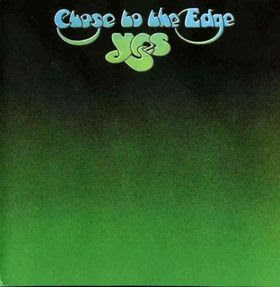
Yes- Close to the Edge

Tomorrow, I’m going to my first ever prog concert, Yes. To commemorate, I’m reviewing the album that generally is considered their best, Close to the Edge. At this time in their carrer, Yes consisted of Jon Anderson (lead vocals), Steve Howe (guitar/vocals), Chris Squire (bass/vocals), Bill Bruford (drums), and Rick Wakeman (keyboards). The band had broken through with The Yes Album (1971), and became one of Prog’s superstars with Fragile (1972). With these strong albums under their belt, Yes made Close to the Edge with little reservation.

This album is the first of a few more by Yes that are centered around one massive track, with shorter ones taking up what’s left of the record. In the case of Close to the Edge, this is the title track. “Close to the Edge” contains four distinct parts making up an 18 minute suite: The Solid Time of Change, Total Mass Retain, I Get Up I Get Down, and Seasons of Man. For the first movement, nature sounds lead into the album. After about a minute, Howe takes over with a truly amazing guitar solo. His style here is very Prog at heart, with lots of fast and technical chord changes and time changes. This, after a semi- stop, leads into the vocal harmonies, with Anderson’s distinct high pitch voice caring the piece (due to a vocal cord defect, he sings in a permanent falsetto.) The song goes through its chorus several times, with little changes between each repetition. The Total Mass Retain phase is brief (less than two minutes), and is very similar in style to what came before. I Get Up I Get Down starts, and suddenly everything mellows. Wakeman adds some keyboard sounds to carry over for a while. This section has little music for its beginning, with just vocal parts over the electronic sounds. Wakeman adds a pipe organ solo at the end. Seasons of Man returns to the structure of Solid Time of Change, with the same guitar, bass, and drum parts. The Keyboards, however, are different. After a vocal only reprise of the other parts, “Close to the Edge” fades out.

That song takes up a whole side of vinyl, but the songs on side B are no slouches either. The first of two songs here is “And You and I”, a love song. Once again, it is a suite, lasting 10 minutes. It also has 4 sections: Chord of Life, Eclipse, The Preacher and the Teacher, and Apocalypse. The sections are less distinct here. Howe’s Acoustic guitar leads in, and he puts in a fantastic performance. Anderson solos for much for much of this song, and his frail voice perfectly fits the lyric content. “And You and I” talks about how when in love, a person is incomplete without the other, and how lovers ought to try to spread this message of Love. This is all done in extremely spiritual way. The keyboards help to create an ethereal mood during the second half of this song. Perhaps Prog’s greatest Love song, it ends by stripping down to the basic guitar part and vocal. Lastly, there’s the nine minute “Siberian Khatru”, the first Yes song I ever heard. After an opening riff, the song has a four measure structure, with three 4/4 ones followed by a 3/4. Vocals come in after about a minute. This song is not a multi part suite, but features many solos by Wakeman and Howe. Squire’s distinctive bass style is very evident on this song, with many slap-bass like notes. Bruford also shine on the drums. “Siberian Khatru” has an energetic feel as parts, but at other parts feels as icy as Siberia.


Close to the Edge was heavily influenced by the book Siddhartha by Hermann Hesse. Stravinsky’s The Rite of Spring also factored into the feel of the album. Roger Dean, the famed Prog Artist, contributed the gatefold illustration, which featured the signature sci-fi landscapes of his work for Yes (above, image from Wikipedia). After this album, Bruford left to join King Crimson, and Yes released Tales from Topographic Oceans (1973), which was received with mixed attitudes.

Close to the Edge is one of the best known Progressive rock albums, and deservadely so. It has great art, lyrics, guitar, bass, drums, keyboards, vocals, and is inventive. What more can we ask from a Prog Album? Not much. Grade: A