So, two days ago, I went to see Yes play on thier In the Present tour at the Tower Theater in Upper Darby, PA. As thier opening act, they had Asia, since Steve Howe was in both bands. All I have to say is I was TOTALY AMAZED! Most prog fans consider Asia a disgrace of sappy pop by prog greats, but this concert proved that's not true. As for Yes, they were fantastic.
Asia has a 9 song set, and I can't really tell you everything that was on it since I'm not familiar with thier distography. The Asia origonals sounded really good, but the higlights were songs from the member's former carrers. For Geoff Downes, they played "Video Killed the Radio Star" by the Buggles. John Wetton got "In the Court of the Crimson King", which initially struck me as odd, seeing he wasn't in King Crimson till 4 albums after In The Court. Then I saw why: Ian McDonald came out to guest on flute! For Carl Palmer, they played "Fanfare for the Common Man", with a fan-tastic drum solo. Honestly, in both bands, Carl was the best player all night. Wetton and Downes played really energetically too. Steve Howe looked like he wasn't too in to it, since he probably wanted to get on to the Yes set. Overall, good stuff.
As for Yes itself, I was blown away. Since Jon Anderson is sick with resperatory problems, Benoit David of Montreal Canada got to be vocalist, and since Rick Wakeman more or less comes and goes in and out of Yes as he pleases, his son Oliver did the 'boards. Then, of course, there was Howe, Squire and White. Chris Squire was the show stealer, moving around his part of the stage and really going at that bass with is distinctive pseudo- slap style. Howe was much more into the Yes stuff than Asia, and Alan White definatly preformed well on the drums. His solo can't hold a candle to Palmer's, but then again, not much can. David not only sounded very similar to Anderson, he looks like him, too! His perfomance was strong. Wakeman was sort of invisible compared to the other four, but did his job well. Here's the setlist, with asterisks next to songs done paticuarly well:
Firebird Suite
Siberian Khatru*
I've Seen All Good People
Tempus Fugit*
Astral Traveller*/ Drum Solo
And You and I
Steve Howe Solo
Owner of a Lonely Heart
Machine Messiah
Roundabout
Heart of the Sunrise*
Starship Trooper* (Encore)
The best concert of my life. Be sure to catch them next time they come to town!
Thursday, July 30, 2009

Monday, July 27, 2009
Yes- Close to the Edge
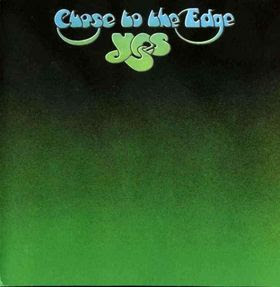 Tomorrow, I’m going to my first ever prog concert, Yes. To commemorate, I’m reviewing the album that generally is considered their best, Close to the Edge. At this time in their carrer, Yes consisted of Jon Anderson (lead vocals), Steve Howe (guitar/vocals), Chris Squire (bass/vocals), Bill Bruford (drums), and Rick Wakeman (keyboards). The band had broken through with The Yes Album (1971), and became one of Prog’s superstars with Fragile (1972). With these strong albums under their belt, Yes made Close to the Edge with little reservation.
This album is the first of a few more by Yes that are centered around one massive track, with shorter ones taking up what’s left of the record. In the case of Close to the Edge, this is the title track. “Close to the Edge” contains four distinct parts making up an 18 minute suite: The Solid Time of Change, Total Mass Retain, I Get Up I Get Down, and Seasons of Man. For the first movement, nature sounds lead into the album. After about a minute, Howe takes over with a truly amazing guitar solo. His style here is very Prog at heart, with lots of fast and technical chord changes and time changes. This, after a semi- stop, leads into the vocal harmonies, with Anderson’s distinct high pitch voice caring the piece (due to a vocal cord defect, he sings in a permanent falsetto.) The song goes through its chorus several times, with little changes between each repetition. The Total Mass Retain phase is brief (less than two minutes), and is very similar in style to what came before. I Get Up I Get Down starts, and suddenly everything mellows. Wakeman adds some keyboard sounds to carry over for a while. This section has little music for its beginning, with just vocal parts over the electronic sounds. Wakeman adds a pipe organ solo at the end. Seasons of Man returns to the structure of Solid Time of Change, with the same guitar, bass, and drum parts. The Keyboards, however, are different. After a vocal only reprise of the other parts, “Close to the Edge” fades out.
That song takes up a whole side of vinyl, but the songs on side B are no slouches either. The first of two songs here is “And You and I”, a love song. Once again, it is a suite, lasting 10 minutes. It also has 4 sections: Chord of Life, Eclipse, The Preacher and the Teacher, and Apocalypse. The sections are less distinct here. Howe’s Acoustic guitar leads in, and he puts in a fantastic performance. Anderson solos for much for much of this song, and his frail voice perfectly fits the lyric content. “And You and I” talks about how when in love, a person is incomplete without the other, and how lovers ought to try to spread this message of Love. This is all done in extremely spiritual way. The keyboards help to create an ethereal mood during the second half of this song. Perhaps Prog’s greatest Love song, it ends by stripping down to the basic guitar part and vocal. Lastly, there’s the nine minute “Siberian Khatru”, the first Yes song I ever heard. After an opening riff, the song has a four measure structure, with three 4/4 ones followed by a 3/4. Vocals come in after about a minute. This song is not a multi part suite, but features many solos by Wakeman and Howe. Squire’s distinctive bass style is very evident on this song, with many slap-bass like notes. Bruford also shine on the drums. “Siberian Khatru” has an energetic feel as parts, but at other parts feels as icy as Siberia.

Close to the Edge was heavily influenced by the book Siddhartha by Hermann Hesse. Stravinsky’s The Rite of Spring also factored into the feel of the album. Roger Dean, the famed Prog Artist, contributed the gatefold illustration, which featured the signature sci-fi landscapes of his work for Yes (above, image from Wikipedia). After this album, Bruford left to join King Crimson, and Yes released Tales from Topographic Oceans (1973), which was received with mixed attitudes.
Close to the Edge is one of the best known Progressive rock albums, and deservadely so. It has great art, lyrics, guitar, bass, drums, keyboards, vocals, and is inventive. What more can we ask from a Prog Album? Not much. Grade: A
Tuesday, July 21, 2009
Neu!- Neu!
 Today I'll take my first dip into one of the largest and most misunderstood subgenres of prog: Krautrock. Neu! were a German duo consisting of Klaus Dinger on drums and Michael Rother on Guitar. In 1971, these two split from famed electronic band Kraftwerk due to their perception of lack of focus. Neu! Began playing underground, and released this self titled debut album in 1972. It sold poorly (30,000 copies), but it is hailed today as a masterpiece by many musicians and fans alike.
This six-track album starts off with “Hallogallo” which is typical of this form of Krautrock in its sheer mellowness. This song is a great example of Dinger’s “Motorik” beat (or “Apache” beat), where he would strip down traditional rock structure to a minimalist, repetitive 4/4 beat. This beat became Neu!’s signature. Rother adds sparse guitar throughout, which creates a mellowed out feel. A cool, spacey little track. After a little over 10 minutes, “Hallogallo” ends and “Sonderangebot” starts. In total contrast to what came before, the song opens with claustrophobic electronic sounds. It continues through all sorts of strange noises, making a very eerie impression. After fading out from ringing noises, we reach “Weissensee” via segway. This song falls somewhere in between the two prior songs, as the feel is both claustrophobic and mellowed. More repetitive drumming from Dinger, but he changes it from time to time so “Weissnensee” can’t be called Motorik. Towards the end, Rother’s guitar takes prominence. The track carries on with minimalism and ends side A.
The B Side begins with “Im Glück”, and water noises. Electric guitar fuzz fades in eventually. The song merely hums along with little things going on in the background. No drumming features, and by far “Im Glück” has the most minimalistic approach on Neu! Water noises take us out of the track for a cycle. Afterwards, “Neagtivland” begins with a jackhammer, dogs barking, and screeches. Neagtiveland is not so much like Neu! Or other mellow Krautrock, it’s more similar to Faust or Early Can, abrasive and difficult on the ears. It flies around with Motorik beat, guitar fuzz, guitar riffs, and a general aggressive feel. “Neagtivland” certantly is the least accessible but most interesting track on the album, including other surprises like sudden stops and tempo changes. The final song is “Lieber Honig”, and unfortunately I consider it Neu!’s weakest. An infant like moan dominates the track, and it is annoying as anything. This is truly a shame, as the guitar in nice and relaxing under it.
Neu! Is not always an engaging album, but is always a strange one. The tracks contrast with each other more than most other albums, but the contrast crates quite a bit of interest. Neu! Pioneered a new minimalist electronic style, which would go on to influence acts as diverse as David Bowie, Radiohead, New Age acts, and their old bandmates in Kraftwerk. Soulless but oddly human, mellow yet slightly aggressive, Neu! proves to somehow be accesable. The album itself is hard to take as a collective since there isn’t great cohesion between many of the tracks. However, when effort is made to seem those few similarities together, we have a work that is fun to listen to. Krautrock is rarely flows so well. Nothing is perfect, yet nothing is horrid.
Neu! Has such strength in its pioneering of drum beats and electronic music that its weaknesses are very easy to overlook, and I’d recommend it for your Prog collection. Grade: B
Wednesday, July 15, 2009
Welcome to The Machine: Growth of Prog
1969 began Prog, but why then? Why not earlier or later? Tonight I seek to answer that question by looking at the history of Rock n’ Roll as a whole, to examine why rock music logically led to prog. Later, in September (after a special Yes feature to commemorate my first prog concert and Italy month in August), I’ll tackle why prog fell.
Rock music was approximately 15 years old at the time of In the Court of the Crimson King. It evolved out of the blues music from the south, which had in itself evolved from religious chants of African American slaves on plantations. Blues, admirably, does nothing to interest me. I find every song to be the exact same, same chords, same melody, only the words change. Obviously, this was not stimulating enough for some. So in the mid 1950’s, the rock n’ roll era of rock came to be.
Stars like Elvis, Chuck Berry, Jerry Lee Lewis, and Little Richard played this music much the same as the blues. While the same noises and chords are repeated, melodies now changed from song to song. Again, this music wasn’t very challenging or interesting from a music theory perspective, but it became popular the world over out of sheer novelty. This state was not to last.
A combination of deaths, drafts, and mediocre records led to “The Wilderness Years” of rock, the early 60’s. Billboard’s chart was flooded by teen idols and pin ups. The music itself became more commercial and less sincere to its roots. This paved the way for the British Invasion. The Beatles came on the scene, and it was the first time a guitar band really became bona-fide stars. They altered all parts of their music, but in their earlier days it was within safe limits. Afterward, The Animals, The Who, and similar bands picked up on the trend.
So, as we can see, rock music evolved from less complex forms of music, and then it continued to become more sophisticated with time. This pattern makes it obvious why proto prog and later prog formed. Yet, more than just the music itself created prog. The historical setting of the era also lent a hand into making progressive rock a reality.
As everyone knows, the 60’s were a time of turmoil and stress. Society nearly buckled under pressure from Vietnam, race riots, drugs, student protests, and the largest shift towards the left since the French revolution 170 years prior. What does this mean for music? With the extra freedom in the philosophy, musical artists challenged themselves with creating more art. This allowed for the emergence of new and more innovative styles.
To be continued.
Sunday, July 5, 2009
King Crimson- Red

Time for an album by King Crimson, the godfathers of prog. Or, in this case, father. By 1974, Crimson had been through numerous lineup changes, with guitarist Robert Fripp the only common thread between them. Red, the 7th studio album and 3rd in the heavy period, consisted of a three member lineup. Fripp had assembled a 5 piece consisting of himself, John Wetton (ex-Family, bass, vocals), Bill Bruford (ex- Yes, drums), David Cross (violin), and Jamie Muir (drums), although after 1973’s Lark’s Tongues in Aspic, Muir left, and Cross followed suit after Starless and Bible Black (1974). Red, released later that year, continued the hard rock/ prog rock mix of the other two, with the heaviest results. All songs are 6-12 minutes.
To start off, we have the instrumental title track. “Red” uses a reoccurring riff over and over, and has little variation. However, the song is not minimalistic, with occasional devotions from the main riff, which also cycle. On the whole, it’s not a very engaging song, despite rocking hard. Next up comes “Fallen Angel”. This song contains the only acoustic guitar on Red, having been a staple of the Crimson sound early in their career. Wetton sings on this track, and his voice suits it well, as it carries over the sparser instrumentation. “Fallen Angel” is the most typical song for King Crimson on Red, which is welcome after the hard rock drone of “Red”. Next up, “One more Red Nightmare” comes on to finish side A. Like “Red”, it repeats a riff, but with the use of vocals and more prominent drums, the guitar repetition annoys less. The song’s melody is fantastic, as well as all the instrumentation and singing. Former member Ian McDonald also guests to add sax.
Unfortunately, after this high comes the live improvisation “Providence” (named after the town where it was recorded.) Preformed while Cross was still a member, violin features prominently. While I respect the difficulty of improvisation, here it just goes on without really engaging. This is countered by the final track, “Starless”. Written by Wetton, this one has it all: interesting guitar/bass, lyrics, drums, more McDonald guest sax. It all comes together to create a creepy, somber mood in the beginning before all turning into a metal noisiest in the last 3 minutes. The clash is absolutely wondrous.
After completeing Red, Fripp disbanded King Crimson until 1981. When they returned, Wetton was gone, replaced by Tiny Levin, and second guitarist Adrian Belew also joined. They would be the first lineup to record two albums with no changes.
Many prog fans consider this one of the greatest albums of all time. I can’t say I agree. While “Starless” is one of the greatest songs of all time, and “Fallen Angel” and “One more Red Nightmare” does not slouch off either, “Red” and “Providence” sound too boring to me. I can ignore a misplaced note and give an album an A, but they take up 15 minutes of a 40 minute album.
Red is a good album, a worthwhile addition to a prog collection, but not essential.
Grade: C+
Monday, June 29, 2009
Prog Related?
For those of you who have never gone for a visit to http://www.progarchives.com/ , it’s a fantastic site with over 20,000 prog albums from over 4,000 bands catalogued. They’ve got a lot more reviews and info than I could ever accumulate here and a forum. But one thing about the site I don’t like is a category, called “Prog Related”. This is an umbrella category designed to hold all sorts of artists that are not prog, but have some progressive influence in their music. Today, I seek to work through an issue I have with this category.
The problem is for way too many of those entries they don’t strike me as having an ounce of prog to them. A smaller number have enough to be at least “Crossover prog”, which is the opposite, progressive music that has influences from mainstream pop in addition to all the jazz and classical. Have a look at their top 5 albums in prog related:
· Queen II- Queen
· Argus- Wishbone Ash
· A Night at The Opera- Queen
· Led Zeppelin IV (a.k.a. Zoso) - Led Zeppelin
· Seventh Son of a Seventh Son- Iron Maiden
Now I like Queen, but what in their music is progressive exactly? From their own site, prog is defined as “a mostly British attempt to elevate rock music to new levels of artistic credibility."[1] Queen does come from Britain, but the problem is Queen doesn’t really elevate rock music to new levels of artistic credibility. They aimed and succeeded at the singles market, and while their songs did vary in genre, very rarely would something progressive make its way in. It’s not that Queen never did anything prog, it’s just that it wasn’t frequent enough to be even considered anywhere in the same ballpark. I like Queen, but because their songs and albums are fun, not progressive.
Led Zeppelin’s and Iron Maiden’s inclusion confuses me even more. These bands are blues/ hard rock and metal, respectively, and those genres are almost contradictory to prog. The focus here is getting famous, taking drugs, having sex. Prog music explicitly stays away from these themes in the music to concentrate on the art value. I own over half of Zeppelin’s albums and have heard most of the rest, and there’s not a thing on any of them that even sounds progressive, let alone is progressive. I’m not as familiar with Iron Maiden, but knowing the 80s heavy metal scene as I do, you can’t be both progressive and metal.
This leads me to my qualm with all these “Progressive Metal” bands like Dream Theatre and similar acts. Prog Metal does have some use, some bands that are not 80’s Hair Metal-type Metal do use unusual chord structures and playing patterns in the music, but the term is way to generalized. The problem is they sound much too similar to pop music, normal metal music, or just standard prog all too often. Whenever I hear a Yamaha grand piano or grunge guitar in “Prog Rock”, I find the music too commercial. It is for these reasons that I concentrate on classic rather than modern prog.
So can music straddle the line between prog and other music? Yes. In my first article, I mentioned Prog can also be called “Art Rock”. This is not entirely true if you want to be a purist. Art rock artists make their music for the sake of making an artistic statement, Progressive rock artists want to elevate rock music by trying something new. For an analogy, Realist painters in the mid 1800’s are art in the same way art music works: Gustav Courbet and John Singer Sergeant wanted to make painting more exact, technical, and anti-Romanticist. They made heavy commentary on the state of the world of painting. Impressionists from the same period are “Progressive”, Claude Monet and Edgar Degas wanted to try new experiments with light and color in their painting.
Obviously, it’s easy to do both at the same time, which is why for many people, myself included, Art rock and Prog rock are interchangeable terms. But when I get very technical, I’ll differentiate. Pink Floyd’s music works as both art and prog rock, as their stuff is both making a statement with the way they do things, and inventive. Jethro Tull, King Crimson, and many more work the same way. “Emerson, Lake, and Palmer” however have a statement to act absolutely ridiculous. Many prog fans pan them for being too much of a joke, such as myself. They did not make a great statement, they just had some fun. ELP are prog, but not art rock. Let’s talk about the last of Prog Related’s Top 5, Argus. This is a hard rock album form 1972. They didn’t really do anything new or close to new, despite deep lyrics and technical playing. They are Art rock, but not prog.
Taking a look at some of the other artists from the top 20 Prog- Related albums we can discard some non-prog like entries Blue Öyster Cult, Metallica, and Muse, and clump the others into an “Art, not Prog” category, like Black Sabbath and David Bowie. From here on, Count Felix’s prog blog declares all art rock albums that are not progressive are fair game on this blog, but I’m not going to waste time on the famous stuff like Sabbath or Bowie. There’s plenty of literature on the internet about them as is.
[1] http://www.progarchives.com/Progressive-rock.asp “A definition of Progressive Rock Music”
Monday, June 22, 2009
Camel- Mirage

Briefly, an announcement. Since Italy and France tied in the recent poll, I’ve decided they both win. Each will have a featured month of strictly Italian or French artists towards the end of the year. There will also be a month celebrating prog's 40th anniversary in October.
Camel is one of my favorite prog bands. Their style of symphonic rock is laid back and often veers into a soundtrack-like mode. While some people hold this against the band, I find this quality relaxing and very listenable. Mirage, released in 1974, shows the band in top form, as the first of a power trio, followed by The Snow Goose (1975) and Moonmadness (1976)
Camel evolved out of an earlier band called The Brew. The classic lineup consisted of Andrew Latimer on guitar/vocals/flute, Peter Bardens on keyboards, Doug Ferguson on bass, and Andy Ward on drums. After playing their way through clubs they released a self titled debut in 1973. Latimer and Bardens did most of the writing and led most of the musical direction. After Mirage as the sophmore effort, Camel started to pick up some notoriety, and The Snow Goose broke them internationally. Their success was always moderate, not great. Camel was sometimes mistakenly associated with Camel cigarettes.
Mirage kicks off with one of the greatest songs of all time, “Freefall”. What a masterpiece this is. After fading in, the bass starts hammering away, then guitar and drums join in. After a while, we hit a chorus, sung spaceily by Latimer. The guitar here is heroic and powerfull. “Freefall” moves through other movements that sweep and drive, until returning to the chorus. Then it all comes to a rock n’ roll ending. Fantastic stuff. It’s followed by “Supertwister”, which is a nice little instrumental flute solo. It’s not very technically advanced or anything, but creates a great mystic mood. This is Camel at their most signature soundtrack-like mood. “Nimrodel/ The Procession/ The White Rider” follows it, and it’s a three part suite. Nimrodel consists of Bardens playing some keyboards with quite an electronic tacky sound. The Procession is… Marching music! It strikes me as something you’d expect from the Sultan’s grand parade. Most of this track’s 9:18 length, however, is The White Rider, which has lyrics about the Lord of The Rings (Most specifically Gandalf.) Sort of a hybrid between the prior two songs, this movement is relaxing yet engaging. After it ends, time for Side B.
Next up comes an instrumental, “Earthrise”. This song also follows that spacey, soundtrack like pattern, going through intense movements with keyboard and guitar. “Earthrise” showcases the cohesion of all the players most effectively, and is perhaps the least minimalistic song on Mirage due to the movements constantly changing. Finally, the album’s Tour De Force arrives, “Lady Fantasy” At 12:45, this song takes it’s time working through the sections. This song is Camel’s best known, but I consider it Mirage’s weakest due to too much quiet noodleing around in the middle without going anywhere for a while. The opening has great keyboard work, and a fantastic vocal, after which a hard rock movement also proves itself quite good. Laitmer stars in many parts with his strong guitar work. There’s a part in the middle where mere guitar hum occupies way too much space. The final movements come back in full force, similar to the openers, and close Mirage off with gusto.
Some themes repeat over the course of Mirage. Many of the songs have a brief intro, move into other movements, and cycle back to it. There’s quite a bit of hard-soft-hard progressions also. Camel’s strength lies in Laitmer’s guitar and their ability to create a heavily atmospheric mood, without even the slightest hint of excess.
While there are some very small faults, Mirage’s strengths are overwhelming and creative. One of symphonic prog’s best albums, I give it a Grade of A.
Subscribe to:
Posts (Atom)
